During this CTS session we went over the brief for our second semester. A new required part for this submission is a physical hand-in of a “documentation of process”. This part would contain 3 to 5 illustrated blog posts, a design rationale and a visual essay. To help us understand what would be expected of our visual essays, we had the chance to look at some examples from the previous year.
In this studio session we where asked to think about our fears. We drew around our body on paper and had to fill the figure with our fears, using digital art, collage, paint, pens etc. When i think of my fears, I divide them into 2 groups – tangible and psychological. Tangible fears are the ones that I would have the “fight or flight” response to, the fear of existing, physical things like spiders, mice, heights and so on. Psychological fears are things that exist only in my head, like hypochondria for example, which is the fear of having a serious illness – which I have had in the past. As of now, my main psychological fears specifically connect with my overwhelming fear of death. I have never really experience a death close to me to the point where I actually morned and felt a significant difference in my life without the person.
Death is still a very strange concept to me, as is ageing – recently, my mother sent me a picture of herself just sitting at home and I got this weird feeling like all of a sudden she had aged 10 years (no offence to my mother). The reality is that to me my parent will always be 40, or have been for the past almost 10 years, knowing that my dad it going to be 49 this year and 50 next year is so strange to me. I see them slowly becoming my grandparents and consequently, myself slowly becoming like them. In a conversation I had with a friend earlier, we talked about an obvious sign that proves your an adult – excitement over kitchen appliances. My friend ordered a blender online an we had an intense conversation about the amazing possibilities of using blenders for around 7 minutes.
I don’t really know how to feel about this, death and ageing, because I haven’t actually felt it yet – I’m still a student, I don’t have a job and I constantly need my mothers approval before buying clothes so, how much of an adult am I?
In a complete change of subject, men and dark alleys – not a good mix. This is maybe the most cute fear I have experienced recently because it was triggered by an incident. I was walking home from the station, it’s a minute walk down the high road, which I don’t mind because it’s usually full of people and has shops and whatever, but a 2 minute walk down my residential street that is achingly quiet and dark. Half way down the road, 30 seconds away from my door, I notice there’s this guy behind me, so i look back and i see him holding a bottle of bear or something in his hand. I start to fast walk and I hear him speed up too so eventually we both end up running. I get to my door and he’s right behind me, my hands are shaking as I try to put the key in the lock and he comes up to my door and my heart is beating so fast – I thought I was going to die of cardiac arrest before he had time to even do or say anything to me. Turns out, he was just friends with my dodgy neighbours downstairs and thought it would be funny to run behind me. So yeah, men and dark alleys – not a good mix.
One final thing, drugs and alcohol. I don’t know what it is, but I have a feeling I’m weaker than most. I’ve always felt this way, I don’t know if my brain is trying to tell me that I have a strange disease that suppresses my ability to recover from drug and alcohol abuse or if it’s just the fear of letting down my mother that has always strongly disapproved of drinking and smoking. I’m so scared of these things that I literally ever imagine myself ever doing them. Drinking I have done under the supervision of my parents at family gatherings or Sunday meals – with moderation and occasion, drugs, however, I don’t ever imagine myself doing. I don’t think I could handle it, I think that I am stressed and anxious enough now and using these substances would only make me feel worse. Some people use weed for medicinal purposes, for anxiety and depression but I think it would have the inverse affect on me.
In CTS today we talked about panel transitions and I was inspired to do try making a comic book page myself. Comics are something I want to start learning more about because I think they are great to learn more about narrative and how to create a good plot line with as little as 3 or 4 images. I decided on a short narrative with a single main character. I hadn’t used my pro markers in a long time but it was nice to reconnect with them, the colours are surprisingly vibrant and they’re super easy to blend which is nice.
In CTS week six we were set a task to curate our own exhibition based on a collection of items from the UAL archives. For this task, it was essential to think about:
The floor-plan, layout and size of the spaces as well as the colours and textures of the floor and walls – seating and other furniture for the viewers.
The items used, not all had to be chosen to display.
How the items would be displayed – Would the originals be used? How would you display them so that they don’t get ruined? We have to decide the best alternative for the intention of the exhibition.
The audience interaction.
Lighting and sound – the ambience of the space can alter the experience.
The amount of people allowed in at the same time, the presence of staff if needed.
Each group was given a box of items from the archives, my group exhibition would have to include items from Stanley Kubrick’s “Eyes Wide Shut”. Although I haven’t seen the movie before, I’m familiar with Kubrick and have some knowledge of the types of movies he makes. It would be quite basic to make an exhibition simply displaying the props from the film, so we decided that we would make something new and more interactive. Vaguely similar to the London Dungeon, we wanted to create a thriller experience that triggered fear.
The box included many small props used in the movie including a 1996 Motorola Clamshell phone (the first flip-phone ever released) and fake bags of tobacco. Considering they are original items, perhaps even used by Tom Cruise or Nicole Kidman, they couldn’t be displayed unless they where placed inside a frame or another type of container.
Left: Band-Aid metal boxes with plasters inside; identical keys with yellow tags; another pair of keys; business cards and a pack of cigarettes. Right: ID cards for St. Matthews Hospital Staff.Band-Aid metal box with real plasters inside and a bag of fake tobacco – possibly fake cannabis; Motorola 1996 StarTAC flip-phone with charging dock; rolling papers for cigarettes and business cards inside a white envelope.Floor-plan idea, quick sketch.
The exhibition will be small, as you enter you will see the phone placed inside a glass box over a receptionist desk, the floors will be white and the lighting ice blue and very strong. There will be some plastic chairs before the desk and a ticket machine where you will receive a number, you’ll only be able to go in when the number is called. From overhead speakers the sound of beeping from a phone will be heard and occasionally a recording of a female voice saying “Hello, this is St. Matthews hospital, how can I help you?”. To enter the main room, you have to pass the thick plastic curtains, the first thing you will see is a spinning wall with ID card tags hung all around. One side of the wall will have ID cards with images and the other without. This room will have red floors and white walls, the light will be very dim and warm. This room sets the scene for the long corridor rooms behind the spinning wall.
The long room on the right is the “Band-Aid” room, which will be covered in plasters, the sound of ripping plasters and tearing paper will be heard through overheard speakers and at the end of the room there will be a Band-Aid box in a glass box.
The left room will have creaky wooden floors and black walls, at the end of the room an old TV will be playing a compilation of videos of people rolling cigarettes. The walls will have bags of fake tobacco, rolling papers and pictures of cigarettes pinned up with gold pins. As well as this, there will be glass boxes hanging from the ceiling with the original pack of cigarettes, rolling papers and pictures from the movie. This room will also have dim lighting but will have voices from the movie layered together with the sound from the video to create a chaotic and packed sound.
‘Surreal Science’ is a selection of exquisite scientific objects from George Loudon’s collection, chosen by London-based artist Salvatore Arancio. Over 200 items created in the 19th century, at the time used for educational purposes, now displayed in an immersive, dreamlike space.
Differing from century old picklings, giant papier-mâché botanical models, freakishly real velvet mushrooms and an “Exploded Skull”, used as a medical teaching tool, this exhibition merges real, unreal and surreal (Cumming, 2018).
Exploded Skull, c. 1900
In addition to these models, Arancio contributes with a custom-made sculpture titled “The Flourescent Host”, an amplification of an ancient axe-head also belonging to Loudon’s Collection; dating from 6000 BC, making it the oldest item of all (Souter, 2018). This kaleidoscopic sculpture is cleverly placed beside the video projection wall, the reflecting multicoloured lights enhancing its iridescent quality and tying it to the surrounding artefacts.
Fluorescent Host, Salvatore Arancio, 2018
Arancio takes these educational models, hidden in classrooms during the 19th and 20th centuries, and presents them as the centre of attention in this 21st century psychedelic experience. This action slightly resembles that of ready-made Art, Marcel Duchamp, for example, is infamously known for relocating and repositioning everyday items – see “Fountain”, 1917.
Anomalous Lemons, related to the idea of ready-made art – mentioned above.
The underlining difference is that most of these items were hand-crafted, created to allow students to further develop their knowledge on nature. Consider the papier-mâché flower models, they’re purposely enlarged to facilitate the study of their physicality.
20 papier-mâché botanical models, 1866 – 1927
This exhibition juxtaposes a variety of media and materials: glass (as seen in the model of a Portuguese man o’war), wax (used for castings of body parts), velvet, ivory, ceramic – featuring prints, illustrative books, drawings and paintings of the same thematic.
Asplenium Bulbiferum, Anna Atkins, 1853
Whitechapel gallery prides itself in presenting rare collections to the public eye, with this exhibition they enable us to access beautifully created educational models that otherwise would have been unnoticed. The concept is definitely different to the most of the other exhibitions occurring currently in London, however it is still very relevant.
Ultimately, as much as we try to stay up to date with Contemporary Art, there is so much content (especially digital) that it can be overwhelming and easily ignored. Forbes writer, Kathryn Tully, quotes Lisa Schiff, New York-based art adviser and a Contemporary Art specialist on the subject of over production: “It changes the nature of the way art is presented. Art works become more like widgets for sale, rather than rare objects.” (2012). This exhibition allows us to access unique items as opposed to minimalistic replicable pieces. It contrasts with what you see at large-scale galleries like Tate Modern or the Saatchi Gallery, because all the items are still valued for their technicality and traditional beauty rather than the concept. However, ‘Surreal Science’ also differs from what you would find at the V&A, due to space in which they are presented.
This exhibition gives you the best of both worlds, a psychedelic historic experience. From my perspective, it definitely appeals to teenagers and young adults but, in parallel, it is very appropriate for younger viewers also. It has a very whimsical, fantasy feel, making it a great place for children.
To conclude, it’s important to mention the great layout of the display; the mix of all medias keeps the audience interested, especially when every piece is working “collaboratively” – each adding to the appeal of the next.
For the 20 minutes we where given to complete the automatic writing task, I decided to go to the library, a quiet and less-distracting space, to try to access my subconscious. There are many ways to access your subconscious – the most ordinary way, through dreaming but since I moved to London on the 18th of September, I haven’t recalled a single dream. In the past my dreams where very vivid, sometimes I was able to drift in and out of them voluntarily, I could wake up and return to the dream when I fell back asleep. Though the lack of dream recollect isn’t proven to be a sign of any mental health problem, it is commonly associated with stress and post-traumatic thought suppression.
I went to Hyde Park today and made some sketches of trees. As I’m trying to develop my own characters, it only makes sense that I develop my own settings too. I experimented with different patterns and densities.
Blogging means researching – this can only be done validly if we use the right tools. In this CTS session, we talked about the alternatives to the most widely used search engine, Google.
UAL offers us a variety of reliable databases that allow us to access the deep web for genuine, unfiltered and factual information. These databases include data from verified sources and credit everything – making it super easy to reference and further extend your research. Using Google can be dichotomous, surely as the most used web search engine, you will find the most information. However, this also means that you will be finding data from untrustworthy sources, written by misinformed people. Wikipedia is the fifth most visited site as of today, we are all familiar with it and have used it in the past for research but in reality, Wikipedia is not exclusively written by graduates and students who have intensively studied about what they are writing. Wikipedia is a free encyclopaedia “written collaboratively by the people you use it” (Wikipedia, 2018), the quality and accuracy of it’s content relies on the efforts of every collaborator. You are as likely to find accurate facts as you are to find subjective fallacious ones, don’t risk it – you are potentially diminishing the value of your own writing.
In this CTS session we reflected on the origin of art and the begging of art history. Art can be found as far back as the year 17,000 (Lascaux Caves in Montignac, France) and 15,000 BC. (Altamira Cave in Santillana del Mar, Spain), in the form of paintings on cave walls like murals, most of animals. It’s uncertain whether art was appreciated back then like it is today, did these people paint out of boredom? Did they use painting to register information instead of writing –using symbols like Hieroglyphics were used in Ancient Egypt? Because this was all so long ago, it’s impossible to know if they kept some kind of sketch book, we don’t know if they painted often or if it was occasional.
The world is so vast, there are a lot of art movements that we won’t ever even know about. I studied History and Culture of Art in school, where I learnt about the entire evolution of art, however, I discover new things constantly. This is the dichotomy of the 21st century, or rather the internet – you are ceaselessly and inevitably assimilating information yet it’s so easy to access and share that it becomes like a never-ending sea of knowledge. Anyone can contribute, so unless you dedicate yourself to finding the real facts and checking the sources, you don’t know if what you find is real or not (this is why referencing is o important!).
As a group, we were asked to write a list of the top 10 most important artists which was a very strange task. I wasn’t sure if I should talk about my personal top ten, the most innovative or simply the most well-known. When I’m discovering an artist, I look beyond their work. To truly appreciate artists you have to study them; it’s important to research about their life so that you can understand their creative process, why they express themselves this way, how their work impacts others.
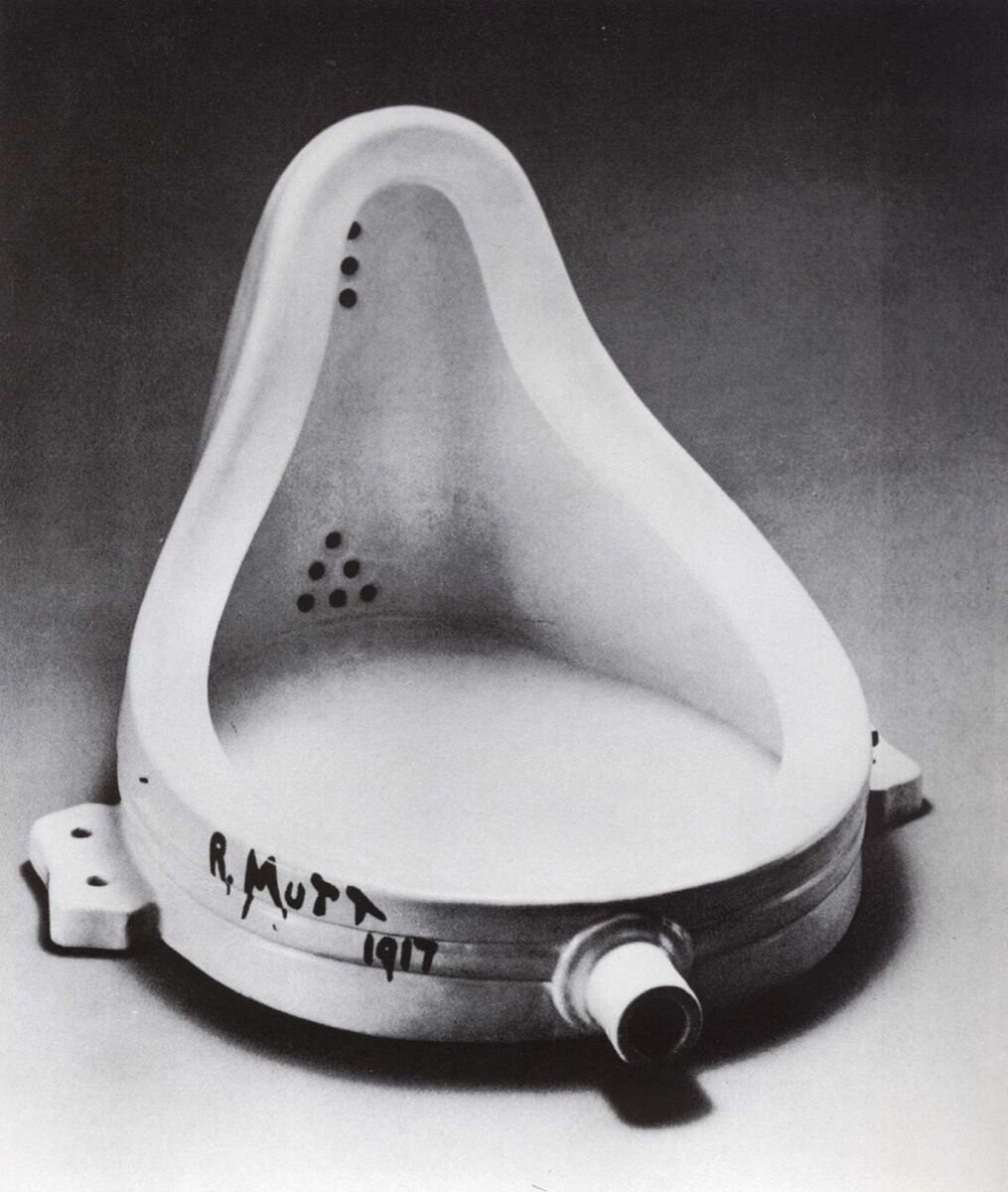
Fountain, Marcel Duchamp. 1917
Let’s consider Marcel Duchamp, infamously known for his conceptual art, his most well-known artwork, “Fountain”, is an upside-down urinal with a signature. In terms of technique, since this sculpture is a ready-made , we can’t evaluate the skill because it wasn’t created by Duchamp, it was simply redefined by him. In this case, we can look to the conceptual value of the piece; like all Dada work, the purpose was to contradict the conventional meaning of art, to be anti-art. Dadaism was unlike any movement, it made people question the traditional standards of art – to this day, it’s still a conflicting topic, some consider this work as art whilst others reject it.
Lady with an Ermine, Leonardo Da Vinci. 1490
Leonardo Da Vinci, on the other hand, paints unparalleled realistic, balanced compositions that are praised by all. Da Vinci recreates reality perfectly, conceivably this is why so many appreciate his work. It is impossible not to admire his technical ability, it’s quite common to say “it looks so real.” and it’s very easy to say this also, nobody can argue against this statement. Traditional oil paintings will continue to be relevant, though many have embraced the natural progression of Art, accepting and valuing artists like Duchamp, others still look exclusively and attentively to realism as the greatest artistic accomplishment of all.
During the second part of the lesson we were asked to discuss two handouts, one on the influence of African Art on Pablo Picasso and the other on the encounters between Japanese and Western cultures.
Pablo Picasso contributed greatly to the genesis of Cubism, together with Georges Braque, they further developed the movement that first came to light in the late works of Paul Cézanne.
The Peppermint Bottle, Paul Cézanne. 1895
In the painting above, we can begin to see elements of Cubism that are also present in the works of Picasso. The flatness of the spaces and objects, noticeable in the background and the green bottle; the geometrical shapes in the blue and white sheets layered over the table, where the objects are placed. But these elements are exceptionally obvious in his landscape paintings.
Château Noir, Paul Cézanne. 1904Mont Sainte Victoire Seen From The Bibemus Quarry, Paul Cézanne. 1897
When studying Cubism in school, my teacher extolled the importance of the fourth dimension. Normally, we are accustomed to three-dimensional paintings: length, height and depth, even so, the third dimension is not present in the painting (object) but in the image, when shading is used correctly— unless the painter uses relief purposely turning the painting (object) into a sculpture. However the fourth dimension, time, is something very innovative and essential to cubism.
Les Demoiselles d’Avignon, Pablo Picasso. 1907
In the painting above, besides the clear use of geometric shapes and block colour, in the faces we can see two facial positions merged together, the frontal and profile view. The eyes are in frontal position but the noses all appear sideways, this could be associated with the time dimension but may also be a result of the influence of African and Iberian Art.
The more you dive into the work of Picasso, the more you realise the similarities to African sculpture. In the painting above, if you pay attention to the two faces on the right, it is obvious that Picasso drew inspiration from African Masks.
Masks linked with the Lega Bwami society, Eastern Congo. 1800-1900
The use of these images in Picasso’s art can be considered cultural appropriation, because Picasso is not part of the Bwami Society nor is he from the Republic of Congo. Another source that has been identified as inspiration for Picasso is ancient Iberian sculpture, but seeing as he is Spanish this is not considered as problematic. Taking in account how popular Picasso is, it’s clear that many people have seen the painting mentioned above and for some people, this may be their first contact with African Art – the way he portrays this culture is very important as it will alter people’s impressions on this culture. This is the main reason people disagree with the use of the masks, because this portrayal can be misleading especially when the artist is misinformed about the culture; Picasso, in fact, never travelled to Africa.
Nonetheless, not everything can be considered appropriation simply because the artist isn’t part of the culture. In the second handout, it became clear that things can be easily labelled as misappropriation even when it’s not the case.
Japanese Costume, Claude Monet. 1876
When talking about Japanese art, we considered the work of Claude Monet. In one of his paintings, he includes a Japanese style bridge which he built in his garden. In another example, Monet paints his wife in a Kimono, with fans in the background – the painting is named “Japanese Costume” (1876). In the second case, it’s more obvious why this would be considered misappropriation, because a Kimono is not a costume but a traditional Japanese garment. As well as this, typical Japanese subject also began to reflect in the work of artists like Edgar Degas, the simple depiction of working women and everyday life replaces the traditional painting of upper class and royalty.
Claw, Kimba the White Lion. Manga: 1950 – 1954; Anime TV series: 1965 – 1966Scar, The Lion King. 1994Left: Mufasa, father of Simba, The Lion King. Right: Caesar, father of Kimba, Kimba the White Lion.
In 1994, Disney’s “The Lion King” was released and received with great reviews. Withal, attentive fans quickly noticed the similarities between the animation film and the Japanese anime series “Kimba the White Lion” that had aired 3 decades before and was created by Osamu Tezuka, considered the “god-father” of manga back in 1950. Although the two have some individuality (“The Lion King” story being tied to Shakespeare’s “Hamlet”) most scenes and characters that are almost identical. However, Osamu Tezuka himself admitted to be influenced by early French, Belgian and Disney Animation. Tezuka passed away in 1989, meaning he never saw “The Lion King” which means we will never get this perspective on this issue.




 stone cold fox